Coding agents change the build versus buy call
Coding agents are shifting how teams decide between licensing software and writing their own code. McKinsey's report State of AI 2026 notes that 32% of…
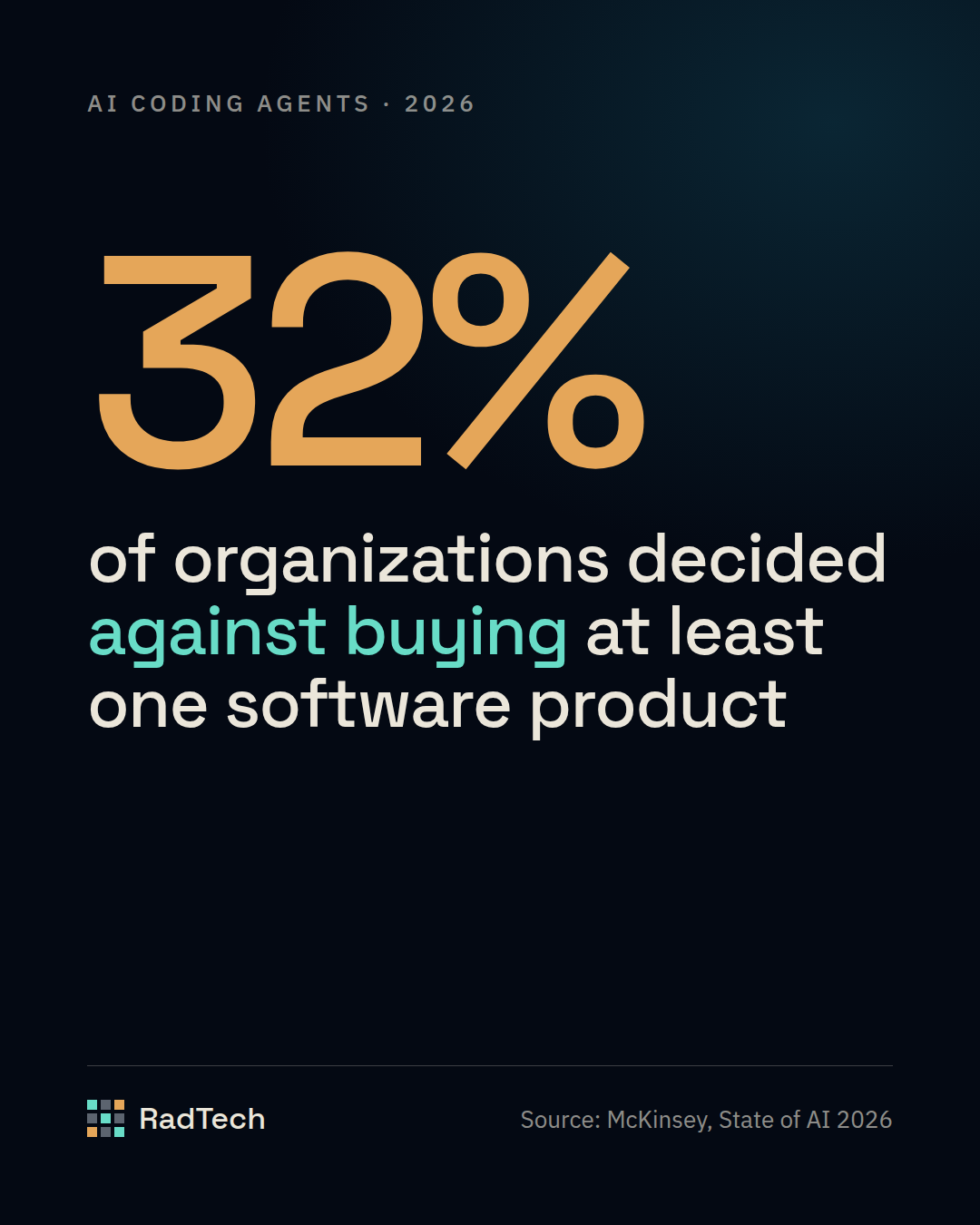
Coding agents are shifting how teams decide between licensing software and writing their own code. McKinsey's report State of AI 2026 notes that 32% of organizations decided against buying at least one software product or feature because they could build it in house with AI coding agents. This article explains how to evaluate that choice for your internal tools. You will learn how to identify candidates for in-house development, what to verify before launch, and how to structure the work so it delivers value without consuming your core team.
Identify what to build first
Start with workflows that are repetitive but low risk. An internal approval tool is a strong candidate. It often replaces a licensed per-seat solution with a simple web interface. An admin panel generated on top of an existing database is another good fit. This approach works well when the data structure is stable and the user base is small. A spreadsheet workflow turned into a small web app also fits this pattern. These tools automate checks that currently eat up team hours.
Check three things before you commit. First, is the workflow stable? If the process changes monthly, a rigid app will break. Second, does the team have the capacity to maintain it? Ownership implies long-term support. Third, is the data sensitive? If it is, you need strict access controls. Avoid building complex customer-facing products with agents in the first pass. Focus on internal utilities where failure is manageable and the benefit is clear.
Scope the work with the model
Do not ask the agent to write the entire application in one prompt. Break the work into clear components. Start with the data layer. Define the inputs and outputs. Then move to the business logic. This is where the rules for approvals or calculations live. Finally, handle the user interface. Keep the interface simple. A basic form and a table view are enough for most internal tools.
We recommend defining the scope in a one-page brief. List the user stories. Describe the edge cases. Specify the error handling. This brief becomes the instruction set for the agent. It also is the test plan for your human reviewers. If you cannot write the brief clearly, the code will not be clear either. The model writes the code, but it does not understand your business context. You must provide that context explicitly. Avoid vague requests. Specific instructions lead to specific code.
Verify the logic before launch
The model writes the code, but a person must verify the logic handles edge cases before launch. This is the critical step. Do not trust the agent to test its own work. Run the tool with real data from your environment. Check for null values. Test for duplicate entries. Verify that permissions work as intended. If an approval is denied, does the system record why? If a calculation fails, does it show an error or a blank field?
We would set up a small test group. Give them a few sample records. Ask them to run their daily tasks through the new tool. Watch for friction points. Note where the workflow feels unnatural. Fix those issues before rolling it out to the wider team. The goal is not to have perfect code. The goal is to have code that works for your specific process. If the tool saves time for ten people, it is a success. If it creates new problems, it is a failure.
Manage the ongoing maintenance
Building the tool is only half the job. You now own it. This means you are responsible for updates. If your database schema changes, the tool may break. If your business rules change, the code must change. Assign a clear owner. This person should not be the only one who knows how the tool works. Document the setup. Keep the source code in a version control system.
We help you decide what to build, what to buy, and then build it. We scope the work to match your team's capacity. We set up the infrastructure so the tool runs reliably. We advise on the data management required to keep the tool accurate. This approach ensures that the in-house solution adds value over time. It prevents the tool from becoming a liability. The shift from renting to owning requires a shift in how you manage software. Treat your internal tools like products. Give them a roadmap and an owner.
What to do next
Review your current software licenses. List the tools that are used by fewer than a handful of people. Check if those tools perform repetitive checks or data entry. Mark the ones that fit the profile of an internal approval tool or a simple admin panel. These are your first candidates for in-house development. Prepare a one-page brief for one of these tools. Define the workflow and the edge cases.
RadTech helps you decide what to build, what to buy, and then build it. We scope the work and build it with you.
// Sources
- The state of AI in 2026: On the road to ROI · McKinsey